
Has it Been Grown?
When we talk about sustainable products we have to look at the entire product development lifecycle.
Is it made out of something grown which could naturally return to the soil or can it be readily recycled.
Does it bio-degrade or could it be recycled?
Paper if made from trees, and there are other sorts of paper such as bamboo, it is hopefully gown as a native plant in a climate wet enough to support fast tree growth and is probably on a piece of land that has for generations been used for paper production. Very sustainable.
What would not be so sustainable, is a non-native tree which requires a high quantity of water such as Blue Gum Eucalyptus and which is grown in an area where there is not a sufficient rainfall to water it naturally.
Makes its own energy?
Similarly, a set of outdoor lights using a solar panel, will be able to be recycled into their component parts. And it generates its own electricity. However, if it is sold in a country that could not recycle it. It would end up in land-fill and not be sustainable. Also, it uses plastics, for the solar cell casing, for the bulb holder and to cover the wiring. Some organic polymers (plastics) are now being made of cellulose (plant based materials) as these become more common place, they will provide a more sustainable alternative to straight plastics.
Safe and non-polluting?
And as with any manufacturing process, is it safely produced. Whether it be organic cotton (cotton production has one of the highest uses of pesticides) so by choosing organically produced cotton, not only is it better for the environment and for the cotton farmers and you know as a producer you are buying a great sustainable product and doing your bit for the environment. Flax and Linen are often seen as much more sustainable.
Resource wise?
And can we get it more environmentally efficient, the benchmark year is 1990. Can we make it use less electricity, water and power than we might have done in 1990. Often, now we can LED light bulbs alone have revolutionised the quantity of power being used across the planet. Recycling water within factories, now means we can – just like most automated car washed – a good percentage of the water used is actually recycled from the previous washes.
Socially acceptable?
And finally – social credentials – have the workers at the factory been paid a decent wage, and not subjected to chemicals etc. Does the product bring us joy on an environmental scale?
Ideally we want a 100% for each of those 5 scores. Realistically though that is highly unlikely but it gives us a benchmark for ranking similar products against each other and working to make them more sustainable.
Let us take my solar fairy light idea above. If the box for the solar panel was made out of bamboo, and made suitably waterproof – bamboo has some naturally waterproofing properties. We might not be able to make the cable safely out of bamboo and we might not be able to make all of the light holder out of bamboo but we could certainly make a start at making a product more sustainable.
Other Eco-Design methods include the one in the link below. This was devised by a group of academics in order for them to teach EcoDesign principles to their students in Sweden. This makes use of the thoughts before manufacture, during use and after use. I can see that it has a place and will certainly look at some of the principles in that cycle. There are some other pretty fundamental ideas for me before we get to that stage. What is the source of the wood or fabric. Is that sustainable, is it organic? What other substances such as glue and varnish that we might need to apply to make the product and how do they contribute positively to the product. A negative connection to me would be that the product has some sort of toxic side effect, pollution for example.
If you want to look at the paper just put the doi link into Google as its an open access academic paper. For those that do not know. All academic papers published in journals since around 2000, have a DOI reference. Making it a bit like an ISBN for academic papers. The date from which the Journal added it to their articles varies with publisher and journal within a publishers list.
This is just a starting point and over time I will be coming up with more concrete criteria, but this is my thinking at this point.
References:
Sustainable Products by Edwin Datschefski
10 Rules for Sustainable Design – doi:10.1016/j.jclepro.2005.11.022
First Ideas about Products and Materials
I have been struggling for the last couple of weeks, having got my first few posts up, they were in many ways the easy ones. Now it is getting more difficult as I get deeper into the subject so please be patient if the posts become a little more sporadic. I want to do this right. For me it is the ideas and thinking process that matters most. Let us look at a relatively simple product of a spectacles or glasses case. I have a number around the house and in handbags. Let me talk you through them and my thinking.
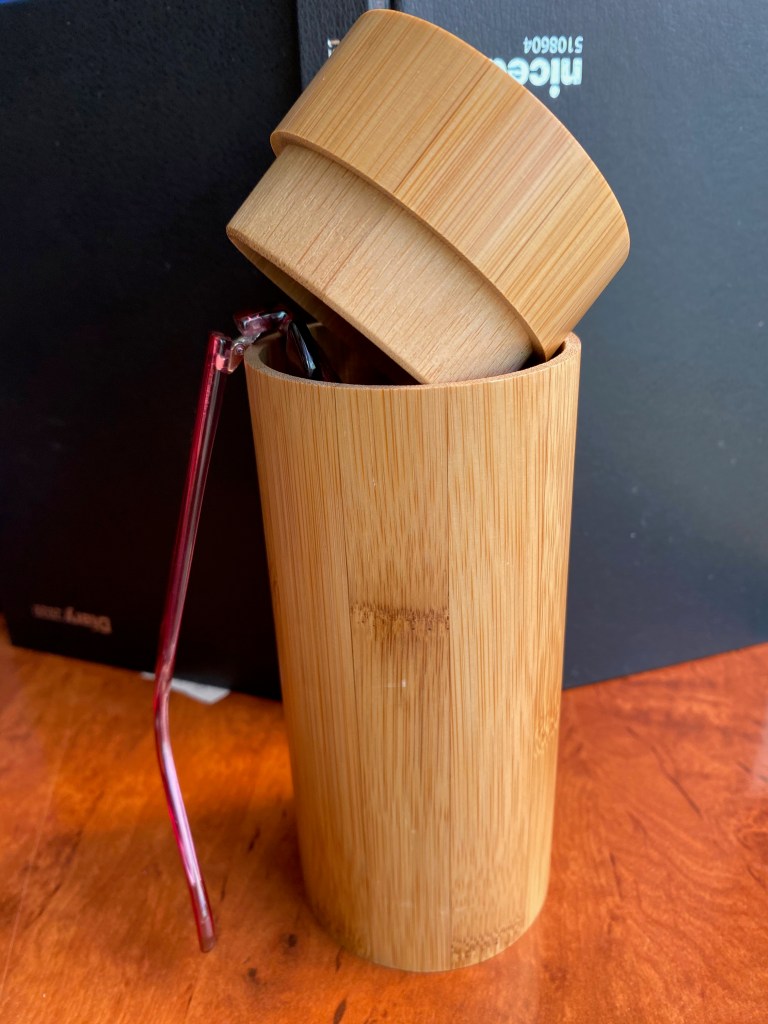
I have a couple of these tall bamboo ones. I love the simplicity of the design and they take up very little space. They are robust, the only down side is they take up a lot of space for travelling.
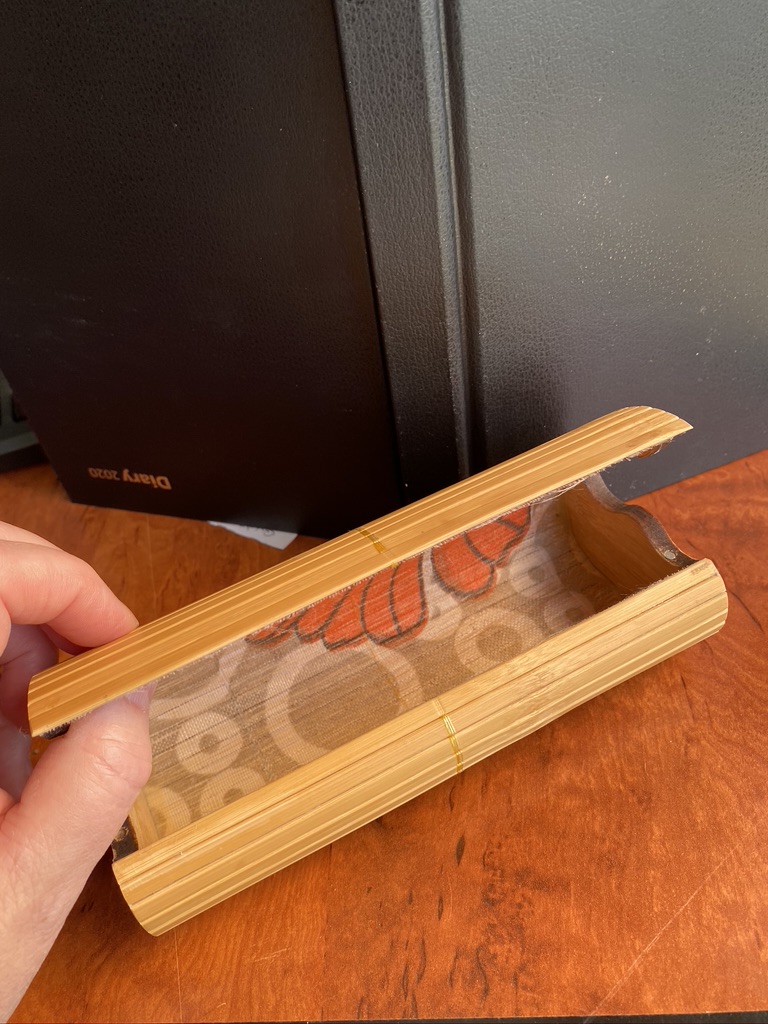
This next type is more compact. I am concerned I might crush it. It has hidden magnets in the area where my thumb is on the curved ends, the case will not stay open. Not great for a work environment where one minute I have my glasses on and the next off. I do like the fabric lining and the outside has a very tactile feel (see below).
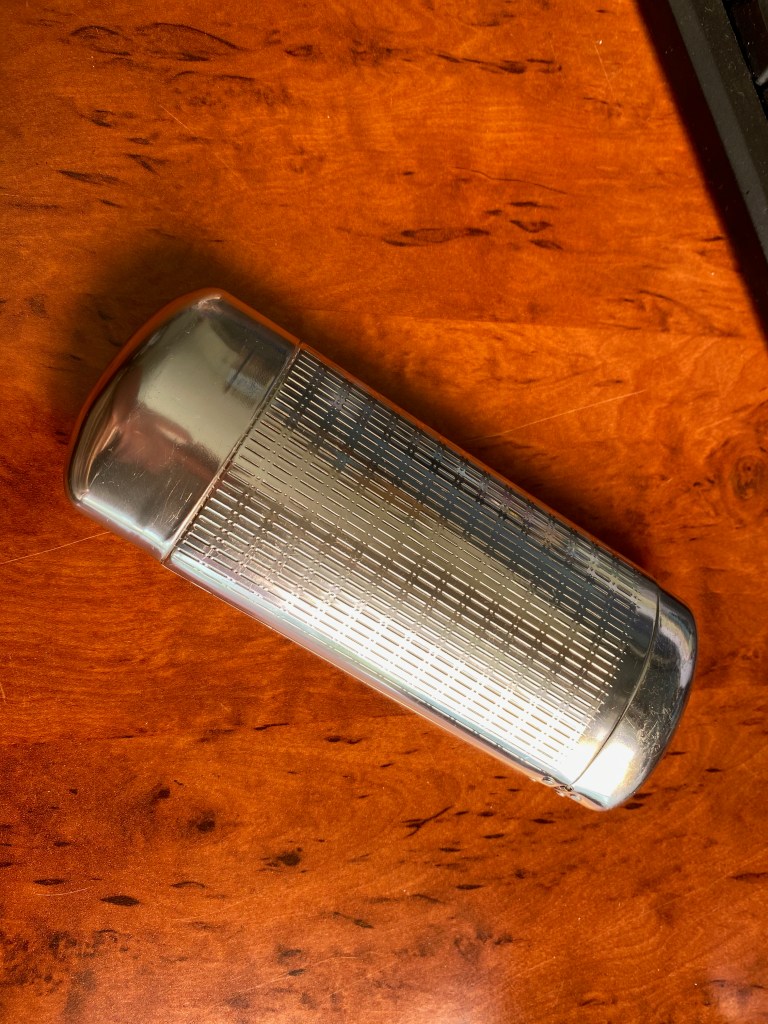
My standard for travelling is an aluminium case as below. This is very robust, holds my glasses and two pens so I can have everything to write my journal while I travel. At least if it was made of recycled Aluminium there would be no further mining impact. And since it is a stamped design there are no other impacts.

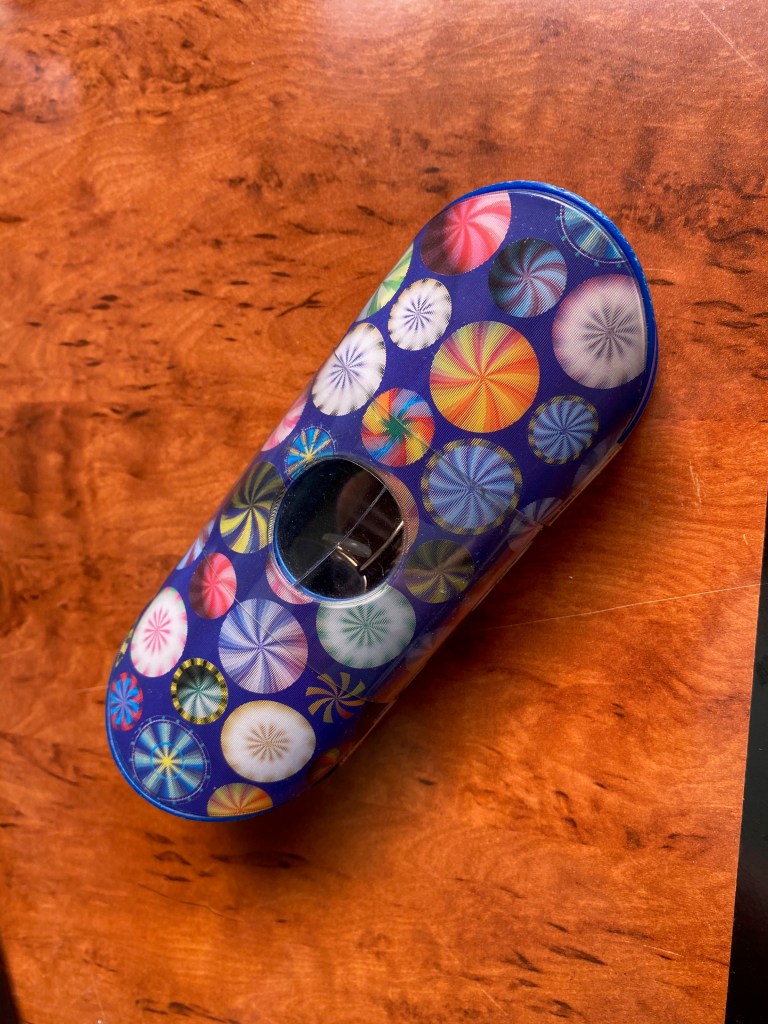
The case on my desk is this plastic one, which I have been trying to replace for a while. The curved top and bottom swivel over each other and one part becomes the base and the top holds the glasses. Perfect for on my desk. I would love a similar design in bamboo – any offers anyone?
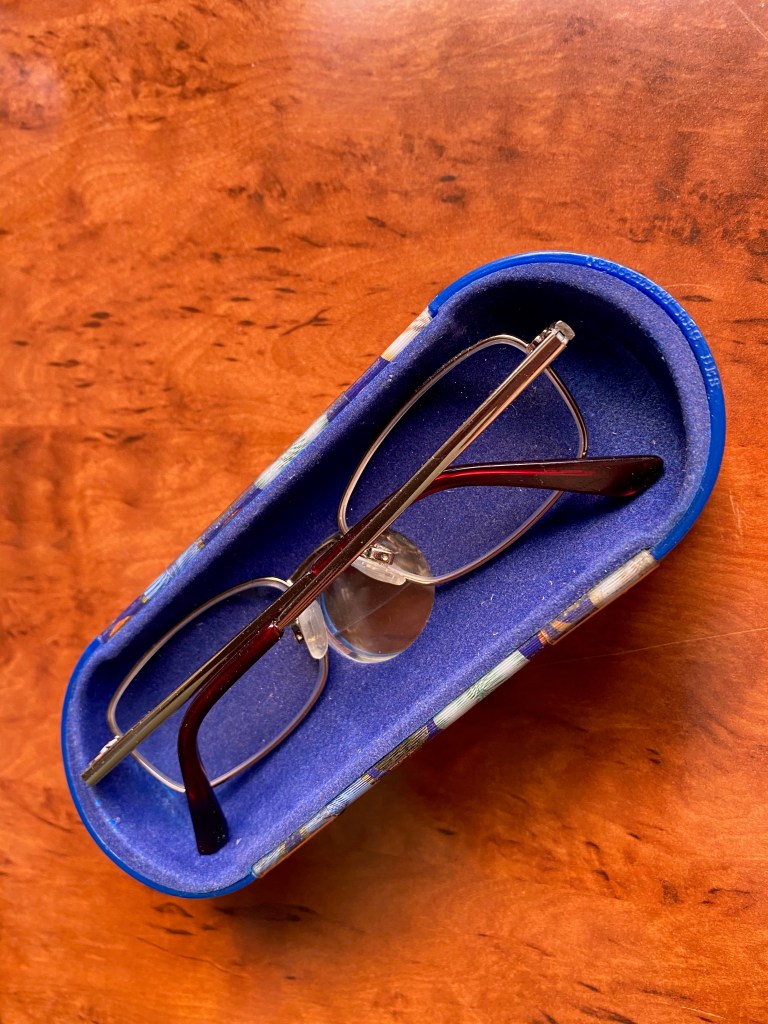
Now I have introduced you to these products you can start to see my (and potential customers) dilemmas. It is horses for courses. I travel a lot and so things that work for me at home may not work on the move. What if I had some sort of physical handicap, say could not grip things well. Actually, the only one that might work then is the fabric lined bamboo case. All the others can be fiddly to open.
I could certainly see the site selling the bamboo cases and if made of recycled aluminium, the metal one as well.
What do you think?
Fabrics – first thoughts
I have also been doing some research on fabrics which has been an eye opener for me, especially cotton, which up to now was one of my favourite fabrics. I have found a great report on fashion fabrics which I will share when I have more to say on that.
Fabrics that I am looking into are: linen, wool, flax and bamboo. There are some others which will take more research into the chemicals used in the manufacture. I am not against the use of chemicals as long as they are sustainable and reusable and can be safely disposed of when used. Dyes also pose these issues. While dyes can be natural materials such as ochre, some chemicals used are harmful. I am in particular thinking of leather dyeing which can be quite a toxic process. More on this later.
 The Bamboo Business